
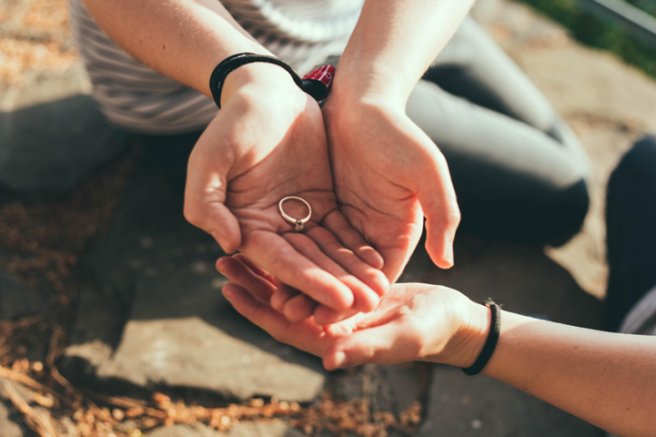
7 captivating engagement ring traditions around the world
Did you know that some Indian brides are married to a tree before the actual marriage to their husbands? As absurd as it may sound, they do this for a reason – to ward off evil curses. While marriage is the most practised social norm around the world, the traditions and rituals are miles apart from culture to culture and some, are downright weird.
In some cases, the engagement is no less fascinating than the actual wedding. From Western Europe to Asia, every region has its own engagement tradition. While Asian people might seem a bit reserved in general, some of their unusual traditions and rituals provide some excitement.
Since the ring is at the forefront of almost all engagement rituals, we're going to explore some fascinating engagement ring traditions from around the world. You might get some fun ideas for your own engagement!
The Origins of the Engagement Ring Traditions
Getting engaged might mean to you that your partner will get down on one knee with a diamond ring in hand. However, it was always not like this. You might be amazed to find that the engagement ring was not always the symbol of love as it is now; in some ancient cultures, it had more to do with signaling ownership.
Egyptians
The tradition of the engagement ring is believed to have originated in ancient Egypt. As you might have guessed, the diamond was not an option back in 4000 BC; they used ivory, leather, hemp, twigs, or even bones for making engagement rings. The Artisan Rings of ancient Egypt were also adorned with colorful beads and engravings.
Egyptians wore the ring on the fourth finger of their left hand, and the reason is quite heart-touching – both literally and figuratively. They believed the “vein of love” runs from the heart to that finger. While there is no such thing as a “love vein,” you certainly have to hand it to the Egyptians for their imaginative thinking.
Neanderthals
Some anthropologists believe the origin of the engagement ring dates back to the Neanderthals. Some Neanderthal male might be the first human to put a crude ring made from a twig on his partner's finger, either to proclaim his loyalty or his love; we might never know why.
The Romans
After the Egyptians, it was the Romans who took the tradition up a notch. But their reason for the engagement ring took a different direction than the Neanderthal loyalty or Egyptian expression of love; to Romans, engagement rings were a sign of ownership.
Was It Always Diamond?
While almost 80 percent of Americans use the diamond ring to proclaim their commitment to their partners, diamonds were not always the chosen material. While you might think the tradition of the diamond ring might have an American origin, it actually comes from Europe.
The first known use of a diamond ring was in Austria back in 1477. The Archduke of Austria betrothed Mary of Burgundy with a diamond ring in the shape of the bride’s initials, “M.” This set off a tradition among the affluent to use diamonds and precious jewels in their engagement rings.
But it was not until diamond mining started in South Africa that the world became fascinated with diamond engagement rings. It was regarded as a worthwhile investment, providing safety against depression or inflation, and diamonds quickly grew in popularity in the world.
Modern Engagement Ring Traditions Across The World
Although engagement rings are ubiquitous to demonstrate commitment, they have different meanings and customs, even in the modern-day. Here are few examples.
Africa
Africa has a rich cultural diversity. In many of them, jewelled beads are used instead of a formal engagement ring. For instance, in Kenya, the groom sends out jewelled beads to the prospective bride's home hoping she will accept them.
If the bride accepts the beads, they are bonded for a wedding. The colour and ornamentation can vary depending on the region or religious belief.
Engagement Ring Traditions in Asia
While in Western culture, entering into an engagement is done by the couple, in Asia the process revolves around the family. Asia has some of the most unique wedding traditions in the world; however, most of them are dying off as people are more inclined to follow Western styles.
China
The Chinese engagement tradition rarely focuses on a ring. They are more focused on sending betrothal gifts to the bride. Most of their engagement rituals can be boiled down to warding off evil and finding auspiciousness.
India
Wedding and engagement traditions in India widely vary depending on the states. In West Bengal, instead of a ring, the woman wears a pair of bangles as a sign that she is engaged. In some parts of India, silver toe rings are worn by women to symbolise their marriage. The two silver rings worn on the second toe of each foot are known as “bichiya,” and women are supposed to wear them throughout their life.
Celtic and Irish
As in many things, the Scottish and Irish are different from the rest of the world. And no, their tradition doesn’t stop just at wearing kilts; even the engagement rings have different meanings and symbols.
For instance, the Irish have a traditional engagement ring called a Claddagh, which symbolises friendship, love, and commitment. The design of two hands clasping a crowned heart has its own legend. In a fishing village in Claddagh lived a man named Richard Joyce. In a cruel twist of fate, he ended up being imprisoned by some outlaw pirates and was sold as a slave in Africa, far away from his true love.
He somehow managed to find an Algerian goldsmith who bought him and let him learn the intricate craftsmanship of jewellery. After 17 years of being imprisoned, he was emancipated and brought back to his village. On his arrival, he found his true love was still awaiting his return even after all those years. That gesture propelled him to express his gratitude to her by crafting an intricate ring, which ended up being the legendary Claddagh ring.
Engagement Ring Traditions in Europe
The custom of wearing an engagement ring is vastly different in Europe than in America. In most parts of Europe, women wear the engagement ring on their left hand, stemming from the Egyptian belief in the vein of love that runs from the left hand to the heart.
However, when they get married, they move the engagement ring to their right hand, pairing it with their wedding ring. It is a great way to symbolise the transition from being engaged to be married, just like graduates turn their tassel from right to the left when they receive their degrees.
As for materials, most European like to use a family heirloom as an engagement ring. For instance, the French prefer a vibrant gemstone or antique engagement rings such as sapphires, rubies, or other precious jewels that hold some emotional value to the couple.
Russian and Nordic Countries
Russians prefer metal wedding bands to diamond rings. However, they have a tradition of triple-band wedding rings where rose, white, and yellow metal bands are interwoven together. However, they don’t have a tradition of separate engagement rings; the couple exchanges just one ring during the wedding.
In Nordic countries, couples opt for simple metal bands for engagement and marriage. In most cases, the bride and the groom wear similar rings.
North America
Just like African traditions, Native Americans also love colour and vibrancy in their engagement ring, and indigenous North Americans have their own preferences for an engagement ring- usually gemstones, coral, or seashells engraved in a silver band. In most cases, the rings symbolise specific powers such as the sun, trees, and animals for the wearer.
In Chile, couples follow a similar custom as the Europeans; they wear the ring on their right hand after engagement but once they are married, they transfer it to the left. In Argentine culture, the wedding ring has less significance than the engagement ring, and often they wear just the engagement ring as a symbol of their commitment.
While Western culture and traditions are a big influence on the regional identity, some traditions are still untouched by westernisation. Those thriving cultures are there to remind us about the beauty of diversity. Many cultures are embracing Western culture but not outright abandoning their own culture. Even Westerners might see a paradigm shift in the coming years. With many Millennials opting for artisan-made precious gemstone rings for their engagement and wedding, the traditional diamond ring might lose its appeal. However, as long as marriage stays as a social norm, so will the practice of exchanging engagement rings.
Image Link-
https://unsplash.com/photos/QvF-T9Mib9I