
The “Chinese Grandmother” beauty philosophy taking 2026 by storm
We have collectively spent the last several years being told that the answer to great skin is more: more steps, more actives, more devices, more “tweakments.” And yet somehow, the most compelling beauty philosophy doing the rounds in 2026 traces its roots not to a Harley Street clinic or a Silicon Valley lab, but to the kitchen of a Chinese grandmother.
The “Chinese Grandmother” approach is being talked about as the breakout beauty philosophy of the year, and its central argument is almost aggressively simple: warmth, circulation and small consistent habits will do more for your skin long-term than any hyper-targeted intervention ever could.
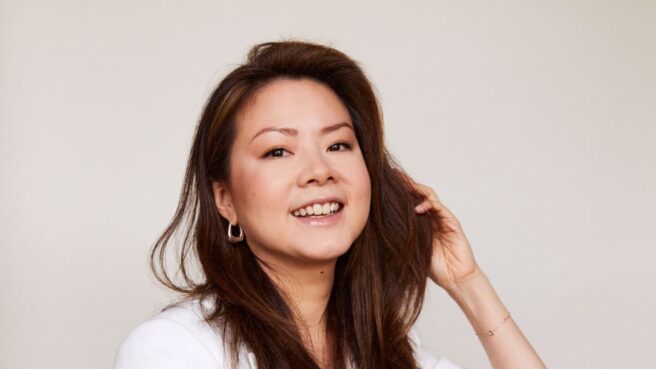
One of its most credentialled advocates is Ada Ooi, integrative medicine clinician, TCM practitioner, and founder of 001 London, the award-winning Harley Street longevity clinic that has earned coverage in The Times, Forbes and Harper’s Bazaar. She’s also, incidentally, the facialist trusted by Jessie Buckley, which tells you a fair amount about the calibre of her clientele.
It starts with your grandmother’s instincts
Ada grew up in Hong Kong, in a family of Chinese Medicine doctors. The rituals she absorbed growing up weren’t framed as beauty routines. They were simply how the women around her lived: attentive to warmth, to circulation, to the body’s rhythms. There was no 12-step concept, no serum layering logic. Just a quiet, accumulated wisdom about what the body actually needs.
“These granny secrets were just a way of life,” Ada has said of her upbringing. That framing matters, because it rejects the idea that skin longevity requires extraordinary intervention. The philosophy she now applies in her clinic and through her proprietary microSculpt® Protocol — which integrates meridian mapping, neurobiology and lymphatic regulation — has those same foundational principles at its core.
Her clinical approach treats the body as what she describes as an “interconnected neuro-physiological ecosystem.” In practice, that means she’s not just looking at your skin in isolation. She’s looking at chronic stress, hormonal imbalance, nervous system regulation and how all of it shows up on your face. She holds an MSc in Psychology with Distinction alongside her TCM training, and her specialisms include fertility, autoimmune disorders, mental health and complex dermatological conditions. It’s a long way from your average facial.
Why “more” might actually be the problem
There’s something quietly subversive about this trend at a moment when the beauty industry is still very much invested in selling complexity. The Chinese Grandmother philosophy doesn’t ask you to strip everything back in a dramatic, viral-detox kind of way. It asks you to be consistent and considered, and to think about what your skin actually needs to function well rather than simply look good in the short term.
Ada’s argument is that the real secret to future-proofing your skin isn’t an extreme hack. It’s a series of small habits, practised regularly, that support circulation and warmth and the body’s own regulatory systems. None of which, she’d likely point out, requires a lengthy product haul.
The bigger picture
What makes Ada’s perspective particularly interesting is where it sits within a broader cultural shift. After years of gua sha tutorials and “skin cycling” threads and the relentless optimisation of every possible variable, a growing number of women seem genuinely fatigued by the amount of effort modern skincare demands. The idea that your grandmother’s approach might actually have been correct all along is, at minimum, a relief.
Ada’s work at 001 London extends well beyond the treatment room. Through lifestyle management, behavioural recalibration and psychological support, she works with clients on long-term health outcomes: functioning better, sleeping deeper, managing chronic conditions more effectively. The skin stuff, in her framework, is almost a by-product of the rest of it.
Which is perhaps the most radical thing about the Chinese Grandmother philosophy. It’s not really about your skin at all.