
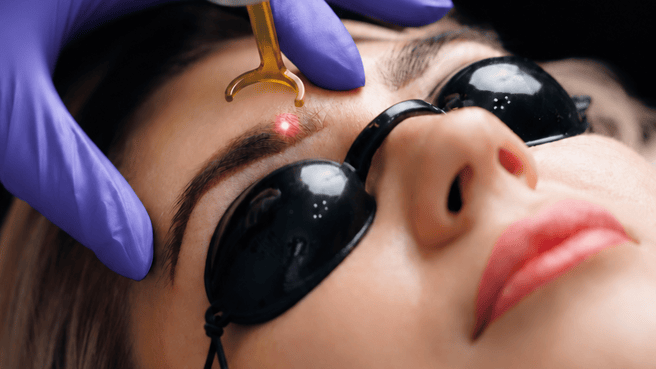
Thérapie Clinic can now remove your old microbladed brows
The brows you had microbladed in 2018 called. They want to know if they can leave.
If you’ve ever sat in a beauty chair, handed over a not-inconsiderable amount of money and said “yes, semi-permanent, please” — only to spend the next few years watching trends shift entirely beneath your very face — you’ll know the particular pain of being stuck with brows that no longer feel like yours. We’ve been through bold and sculpted, then fluffy and brushed-up, then laminated, then soap brows, and now the direction is softer, straighter and lighter. Which is all very well, unless your brows are still firmly living their best 2016 moment.
Thérapie Clinic has launched an Eyebrow Tattoo Removal treatment designed to help clients fade or remove microblading, powder brows, ombré brows, combination brows and uneven or patchy pigment. It’s the kind of option that a lot of people didn’t realise existed — or assumed would be too complicated, too painful or simply not worth the effort.
So how does it actually work?
The treatment uses Cynosure PicoWay, a picosecond laser technology that breaks down tattoo pigment into tiny particles that the body then gradually clears. Rather than working primarily through heat, the technology creates what’s known as a photoacoustic effect — targeting the pigment while minimising disruption to the surrounding skin and, crucially, the brow hair follicles themselves.
Kerri Ann Grant, Skin Specialist at Thérapie Clinic, explains it well: “Brows are such a personal feature, and what someone wanted when they first had microblading or semi-permanent brows done might not be what they want several years later. We’re seeing clients who simply want the option to soften or fade an old shape or pigment and start again.”
She’s not wrong. The whole point of semi-permanent makeup was supposed to be convenience — waking up with brows already done, no faff, no pencil. What nobody quite accounted for was the speed at which brow aesthetics would keep evolving, leaving a fair few of us with faces that belong to a different era.
What does the process look like?
It isn’t a one-and-done situation, which is worth knowing going in. Most clients will need three to six sessions, spaced roughly six to eight weeks apart, with the pigment fading gradually throughout the course. Each session takes approximately 15 to 30 minutes, and the exact plan depends on the individual and the pigment being treated.
Grant adds: “How the pigment responds can vary from person to person, so we always start with a consultation to assess the brows, understand what the client wants to achieve and recommend the most appropriate treatment plan. The treatment is very much designed to get brows back to basics — helping clients return to a more natural look without damaging follicles and the potential for healthy regrowth.”
The consultation-first approach is reassuring. This isn’t a case of turning up and hoping for the best — it’s a proper assessment of what’s there, what you want gone and how to get there without making things worse along the way.
Is this the end of the permanent brow era?
Not necessarily. Plenty of people are still getting microblading and loving it, and there’s nothing wrong with that. But the broader brow conversation has shifted — we’re in a more individual, less prescriptive phase now, where the goal is finding the shape and style that works for your face rather than chasing whatever look dominated your For You page last month.
The fact that removal is now a genuinely viable option changes the calculus a little. Committing to semi-permanent anything feels less fraught when you know there’s a route back if it stops working for you. And for anyone already sitting with brows they’ve grown to quietly resent every morning, the option to start fresh is probably very welcome news.
For more information about Eyebrow Tattoo Removal and other treatments, visit therapieclinic.com.